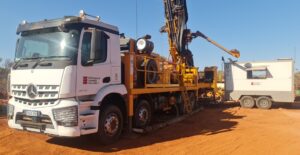
Westralian Diamond Drillers (WDD) officially got its name in 1965, starting as a humble family business and growing to over 120 employees who provide surface exploration diamond drilling services to the mining sector.
With a growing fleet of ten drill rigs and an extensive array of auxiliary equipment and support vehicles, Westralian Diamond Drillers is a ‘one stop shop’ equipped with all the necessities to undertake a successful exploration and production campaign no matter the geographical location or environment faced before them.
Mitigation of risk is at the forefront of ensuring a safe and successful drilling program is maintained, which is why WDD has continually strived to ensure the safety of all workers and visitors whether that be at the frontline on a drill rig or in the Kalgoorlie yard.
As a company that prides itself on the core values of dedication, trust, transparency, quality of work, and customer satisfaction, several years ago the Kalgoorlie-Boulder company recognised an area of improvement would be to increase the accuracy and efficiency of its on-field reporting.
During the past decade, the safety and compliance reporting required to win tenders and demonstrate due diligence for projects has become increasingly rigorous. Additional checklists meant it was becoming increasingly time-consuming to correct mistakes on digital or manual forms back at the office.
 Michael La Machia, Westralian Diamond Drillers’ HSE&T Advisor of more than seven years, said the safety of staff and operating equipment had always been paramount, however tenders and contract reporting needed to be backed by reported evidence that could be passed on to current and prospective clients.
Michael and his team recognised that its paper-based and software systems were resulting in too much human error in the field – particularly from personnel whose primary role was not to do administrative tasks but to provide labour.
As forms for site labourers were not pre-populated with standardised answers, miscommunication could easily occur, including approximately 25% of all mistakes on forms being attributed to typos alone.
 Already familiar with Mackay Safety’s 4PS forms, in 2021 Michael worked with the team at Mackay Safety to develop a PLOD system that would be fit for the reporting requirements of Westralian Diamond Drillers and hard rock drilling.
Crafted and developed in Australia since 2018, the Intelligent Progressive Log of Drilling (iPlod), also known as DDR/DOR is loaded with advanced features tailored for the exploration drilling industry, including:
iPlod can be complemented with Mackay Safety’s groundbreaking 4PS Software to optimise compliance tracking for:
Additional iPlod features/benefits include:
Michael said: “iPlod is now our daily record for what our drillers do at every shift – telling our clients what they did, what tools and products they used, how many minutes they spent in an area, what products they used, and where the drilling was left at before shift changeover.
“The software automatically sends the daily report to clients, and it does have the ability to invoice clients based on the work performed although we aren’t using that feature yet – instead double-checking accuracy of inputted information back at the office. Using 4PS Forms and the iPlod software through Mackay Safety has helped to make life easier for the staff on the front line and eliminated misunderstandings. The forms have pre-populated information that employees can select from a drop-down menu, and this eliminates most errors.”
Michael said other company’s software packages were considered but were deemed too simple for the job at hand.
“Mackay Safety’s software systems were more complex, which was better, however you don’t need to be tech-savvy to use it either. We like that we can go in and change questions or information in the system ourselves too which is great for efficiency.”
Michael estimated that using Mackay Safety’s software has resulted in 40-50 hours time saved a week across all areas of the business, including 10-20 hours in the safety division alone.
 As the system alerts Westralian Diamond Drilling to maintenance checks, licence and initial aid updates for staff, and drug and alcohol testing, the business can operate proactively rather than reactively.
“Particularly beneficial is our site employees’ ability to upload photos of broken machinery for our maintenance crews to see. You can write down what you think is wrong with a machine when it breaks but really, it’s guess work unless you’re a mechanic. Due to the time involved in ordering parts and travelling to site, having a photo to look at instantly means that our maintenance crews aren’t buying a $600 part when really, they only needed to replace a rubber seal worth $20. And that’s just one example. The software is saving us so much time and money.”
--
Thank you to Michael La Macchia for sharing his experience with Mackay Safety and 4PS software.
Contact Mackay Safety today on 07 4944 1272 or visit our website at mackaysafety.com.au to learn more about how we can support your operations with services and technology that ensure you keep on top of your safety and compliance requirements.
Enhancing safety on Australian drilling sites is a critical focus for the industry, and one of the most effective tools for achieving this is the use of Daily Observation Reports (DORs).
These reports play a vital role in improving safety protocols and streamlining incident reporting, offering a structured framework for identifying risks, monitoring compliance, and fostering a proactive safety culture.
In this blog, we’ll explore the risks faced by the drilling industry and delve into the critical role DORs play in addressing them.
Drilling sites – whether for mining, oil, gas, or water – are among the most hazardous workplaces in the world.
The use of heavy machinery, high-pressure systems, and exposure to extreme environmental conditions make these sites particularly risky.
Even in Australia, where best-practice safety standards are a priority, challenges persist.
A robust safety culture is not just a legal requirement but an ethical and operational necessity.
Effective safety measures reduce accidents, protect lives, and contribute to the long-term success of operations.
Drilling sites present a complex set of challenges that include:
Addressing these risks is crucial for protecting lives, ensuring compliance, and enhancing stakeholder trust in an industry already challenged by labour shortages.
Proactive safety measures are essential for ensuring worker well-being and operational efficiency. Recommended practices include:
A Daily Observation Report (DOR) is a structured log used in high-risk industries like construction, oil and gas, mining, and drilling.
These reports document daily activities, site conditions, and safety observations, providing a vital tool for ensuring compliance and managing risks effectively.
DORs serve several critical purposes, including:
Key components of a DOR
A comprehensive DOR typically records:
DORs create a clear and real-time picture of site conditions, enabling proactive safety management.
They enhance communication between teams, streamline compliance, and provide a thorough record for audits.
DORs play an essential role in identifying hazards and improving risk assessments.
By offering a systematic record of site activities, they help prevent future incidents through refined safety protocols.
DORs encourage teams to actively monitor their environment and document potential risks.
This proactive approach uncovers patterns – such as recurring equipment issues or unsafe practices – that may otherwise go unnoticed, enabling targeted interventions.
The daily review of DORs provides immediate insights into emerging risks, allowing supervisors to take corrective actions swiftly.
For example, deteriorating ground conditions or a malfunctioning piece of machinery can be addressed before escalating into an accident.
Digital tools further enhance this process by enabling instant sharing of data, fostering faster decision-making, and maintaining dynamic, responsive safety measures.
DORs simplify the incident reporting process by integrating it into daily workflows, ensuring efficiency and accountability.
With their structured format, DORs eliminate the need for separate incident reporting systems.
Incidents are documented systematically, reducing the risk of oversight or delays in reporting.
DORs centralise incident data, providing stakeholders with clear visibility into actions taken on-site.
This transparency fosters trust, while the assignment of responsibilities ensures accountability for incident resolution.
Integrating DORs into drilling operations enhances safety, reduces workplace incidents, and ensures compliance with Australian safety regulations.
By encouraging real-time documentation of risks, DORs help teams address hazards proactively.
The daily review process reinforces a safety-first mindset, reducing the likelihood of accidents.
DORs simplify adherence to the Work Health and Safety (WHS) Act by providing detailed records of safety measures and incident responses. These records ensure sites are audit-ready and demonstrate a commitment to regulatory compliance.
Additionally, DORs improve communication during shift handovers, reducing misunderstandings and fostering a more organised, safer work environment.
The successful integration of DORs into daily operations requires structured workflows, team training, and the use of advanced technology.
Proper training ensures that all team members understand the importance of DORs and know how to complete them accurately. Key elements include:
Digital tools significantly enhance DOR processes through:
The DOR system should evolve with operational needs. Regular reviews, team feedback, and technology updates ensure its ongoing effectiveness.
DORs are indispensable for maintaining safety, efficiency, and compliance on Australian drilling sites.
By systematically documenting daily activities and hazards, they enable teams to proactively address risks and ensure transparent communication.
Mackay Safety supports your business in adopting effective safety strategies and integrating DORs into operations through our innovative 4PS software tools.
From expert training to cutting-edge reporting solutions, we’re here to help you prioritise safety and achieve long-term success.
Contact us today to learn more about how we can support your safety and operational goals.
Safety Management Systems (SMS) are an important software component of any workplace, particularly in high-risk industries like mining, construction, manufacturing, maritime, energy, and aviation.
They are essential for ensuring employee safety, training, preventing workplace accidents and errors, and adhering to workplace health and safety regulations.
This article explains more about the components of safety systems, the role they have in keeping costs down, but above all how they prioritise your employees’ safety and wellbeing.
Safety means being free from harm or danger, and management is how you prevent potential risks from occurring.
In the workplace, safety management includes:
Anyone who has run their own business will understand the importance of having a safety management system (SMS).
Without one, too many hours are wasted on manually keeping track of staff training, competencies, health and safety certifications, compliance, equipment maintenance, and so on.
Businesses with SMS software can easily identify and manage risks, which helps prevent costly accidents, insurance claims, fines, or legal action.
Above all else, it ensures your most important asset – your staff – know their health and safety is being put first. This too, helps your company become an employer of choice in the industry, ensuring you attract the best candidates for job vacancies. It also helps your company retain valued employees.
Safety is a fundamental requirement in the workplace, and in heavily-regulated industries its importance is often highlighted as part of a company’s values.
An SMS manages safety comprehensively. It helps humans assess risks and introduce controls to prevent injuries, illnesses, and accidents. Managers can use their SMS as a tool to create safer workplaces and ensure compliance with regulatory requirements.
A well-implemented SMS improves productivity, reduces costs associated with workplace incidents, and improves a company’s reputation.
In summary, the key benefits of an SMS include:
The 5 pillars of effective safety management systems include:
Your company’s safety policies and objectives are the foundation of your SMS. Your company’s expectations and commitments about workplace health and safety, along with any goals, are detailed here and communicated with employees.
Clear methods and procedures are set, and employees are actively encouraged and empowered to report and address safety issues as part of their commitment to teamwork. This section should be reviewed regularly to ensure relevance and effectiveness.
A critical component of an SMS is a Hazard Identification and Risk Assessment (HIRA). Potential hazards are identified within a workplace and the risks associated with those hazards. The aim is to reduce the likelihood and/or severity of harm associated with each hazard.
Hazards could be physical, chemical, biological or psychological and pose potential harm to people, equipment, the environment or a system that is in place. A risk assessment on each hazard will determine what the consequences are of the hazard. Each hazard is prioritised in terms of risk, with the highest at the top and the lowest at the bottom. Priority is given to the highest risks first, as they pose the most potential threat.
An appropriate control is then allocated to each hazard. Sometimes management may believe a hazard is too risky and therefore it should be eliminated, while in other cases a decision might be made to mitigate the risk as much as possible. Controls might be policies or procedures that employees, contractors and visitors must adhere to while on site or in the workplace. Another example of a control might be engineered, such as installing a fence or barrier around no-go zones.
A control might also be as simple as a sign during flu season, reminding people of the importance of covering sneezes and washing their hands to prevent illness from spreading.
To gain a positive safety culture within your workplace, you need to empower people to follow the guidelines your company has laid out in the SMS. Staff members are assigned roles that oversee safety management and give oversight about how to manage work, health, and safety risks. They are given key responsibilities, which might include establishing safety committees to oversee the SMS, or actionable items on the SMS. They also evaluate the effectiveness of control strategies and support the identification of new hazards and how to minimise risks. In workplaces they are commonly given titles such as ‘onsite health and safety advisors’ or ‘WHS risk management consultants’.
Training, communications, and actionable activities fall into this category.
New employees need introductory training, and current employees need regular safety training, to ensure safety is at the forefront of everyone’s minds within your company.
The SMS includes open reporting channels for staff to report hazards, incidents, or illnesses freely and without fear of any retribution. Under this pillar, staff understand their safety responsibilities, and how to alert or communicate incidents or concerns.
Training records, equipment or property certificates, incident reports, and safety audits should be stored in the SMS and be readily available to employees, supervisors, or safety mangers, etc, when they are needed. This helps with monitoring what areas/hazards/equipment need improvements to safety, or which certifications and training needs to be updated.
SMS software needs to seamlessly integrate with other software within your company, to ensure efficient operations. It also needs to be scalable as your company grows.
Your company is unique, which is why Mackay Safety ensures safety management software is tailored to your company’s industry and the specific needs of your business. Tailored solutions include customised reporting, flexible safety protocols adjusted for teams and departments, and alerts or notifications for specific reminders.
Best of all, you can access your tailored SMS solution easily through our mobile app.
Nothing new comes without its challenges. The biggest hurdle with change is bringing staff on the journey as it can be exciting for some and daunting for others.
Mackay Safety believes the most effective way to engage staff members on the SMS journey is by promoting the benefits and encouraging safe work practices through consistent reinforcement.
Overcome resistance by:
SMS software is an integral part of sustainable business operations, and should incorporate policies, plans, procedures, forms, records and more, which are tailored specifically to your company’s operational needs.
These are part of the safety management system pillars and are a critical component of workplace safety.
Mackay Safety provides creative and practical solutions using both paper-based, and digitised applications (through 4PS and 4P Forms) to maintain and streamline your processes.
Our systems are simple to follow, developed by experienced consultants, and offer real value for money.
At Mackay Safety, we have a range of services including ICAM accident investigation (incident cause analysis method), exploration safety services, independent auditing services, and safety management plans, systems and advice.
Contact us today for a free consultation or for more information, visit www.mackaysafety.com.au or phone +61 7 4944 1272.