In the resources sector, safety often conjures images of PPE, pre-starts, and hazard reports, all critical, physical aspects of risk management. However, psychological safety is equally important and increasingly recognised under new codes of practice around psychosocial risks at work.
Mackay Safety’s latest innovation – a custom-developed payroll dashboard for a reputable drilling and rehabilitation company, Central Queensland Exploration (CQE) – is an example of what happens when organisations treat psychological health as seriously as physical safety. Built in partnership with CQE’s finance and safety teams, the project employed a work redesign approach to eliminate job stressors that had been quietly, yet consistently, affecting employee wellbeing.
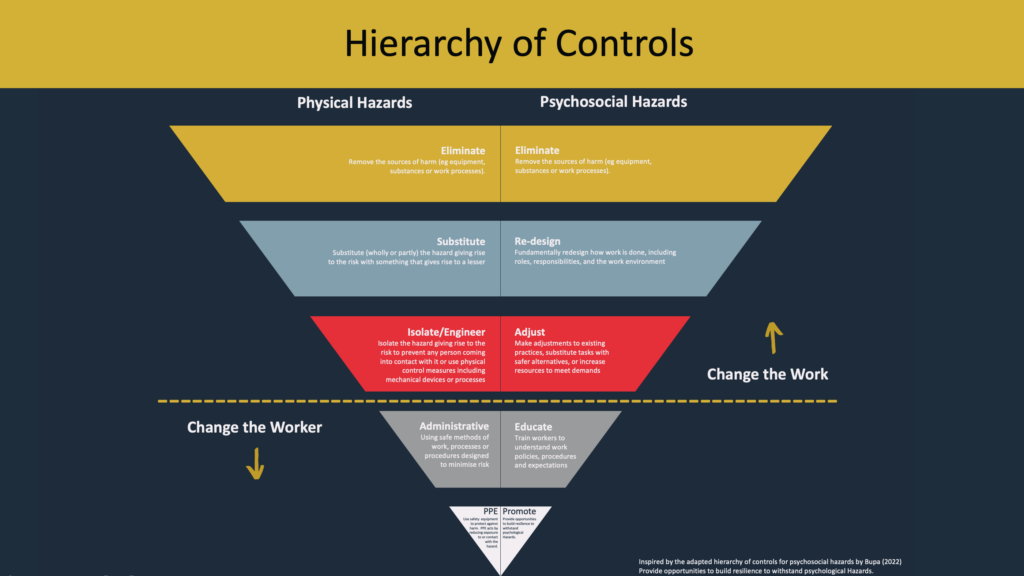
“Work pressure is the leading cause of psychosocial injuries in Australia,” Naomi explained. “And in high-cognition roles like payroll, especially when there’s little room for error, the mental load is significant.”
Rather than treating stress as an individual issue, CQE and Mackay Safety tackled the root cause: the design of the payroll process itself. Using the hierarchy of controls to guide decision-making, Mackay Safety collaborated with CQE to develop a custom payroll dashboard that effectively mitigated key psychosocial risks by automating manual tasks, reducing emotional strain, and enhancing role clarity.
“We weren’t just digitising for efficiency – we were reducing harm,” said Mick Storch, founder and managing director of Mackay Safety. “It was about building systems that support people to do their jobs without unnecessary stress.”
The dashboard integrates with CQE’s existing 4PS software and accounting platform. Timesheet data is now entered once via a mobile-friendly form, approved digitally, and automatically transferred into payroll, eliminating emails, rekeying, and errors. For field staff, it means clearer expectations and smoother pay cycles. For finance, it means better workflows and fewer headaches.
Since implementing the system, CQE has halved payroll processing time – from three days to around one and a half – while improving accuracy and team satisfaction.
Importantly, the solution wasn’t a one-size-fits-all product. It was a collaborative development tailored to CQE’s unique needs.
“You don’t just get software with Mackay Safety – you get a partner who listens, adapts, and genuinely cares about outcomes,” said Simon Harris, CQE HSE Manager.
“The time savings were immediate, but what’s been more powerful is the change in atmosphere,” said Sidney Potter, CQE Accounts Administrator. “People aren’t stressed about delays or chasing approvals. They’re more confident in the process – and in us.”
These efficiencies have also freed up time for more value-adding work. As CQE HSE Manager Simon Harris observed, the gains from streamlined systems multiply in ways that are hard to quantify – building quiet confidence across teams and creating a flow-on effect at the coalface.
This success mirrors other changes Mackay Safety has delivered for CQE using its 4PS software. From digital asset management to compliance workflows and pre-starts, the company’s approach consistently reduces both physical and psychological hazards by improving work design.
While the dashboard itself focused on payroll, the ripple effects have improved safety culture across CQE. Team members feel heard, processes feel fairer, and communication flows more easily between departments.
As Naomi Armitage noted in her keynote speech at the Resource Industry Network Safety Conference about designing effective psychosocial risk management controls, focusing on work design, many workplace tensions, from interpersonal conflict to disengagement, stem from unclear roles, procedural injustice, or avoidable stressors. Mackay Safety’s digital systems reduce these “work factors” by increasing transparency and reducing friction.
“Too often, businesses wait for issues like burnout or disengagement to surface before acting,” Naomi Armitage said. “But the best controls eliminate exposure, which is exactly what this payroll dashboard has done.”
Simon Harris also noted that a single system improvement, when thoughtfully implemented, can drive widespread cultural change, enabling businesses like CQE to handle future growth without sacrificing wellbeing.
This dual emphasis on mental and physical safety reflects Mackay Safety’s broader philosophy. Across all client projects, the goal is the same: to make safety second nature.
The CQE payroll dashboard is already having an impact on other areas of the business. Similar design principles are now being explored to manage training, equipment tickets, and role-based access, all through a psychosocial lens.
Mackay Safety’s ability to evolve its tools in partnership with clients is what makes its safety impact so enduring. Mick Storch believes this consultative, user-led approach will become even more vital as the industry faces growing pressure to address psychological risk.
“Safety isn’t just hard hats and high-vis anymore,” he said. “It’s clarity, confidence, and culture. And those things start with how you design your work.”
Mackay Safety’s payroll dashboard project with CQE demonstrates how innovation, collaboration, and a people-first mindset can drive real change in workplace safety. By eliminating psychosocial hazards at the systems level, Mackay Safety has enhanced efficiency and contributed to creating a safer and healthier work environment.
--
Thank you to the team at CQE for sharing their experience partnering with Mackay Safety and 4PS software.
Contact Mackay Safety today on 07 4944 1272 or explore the website to learn more about how we can support your operations with services and technology that ensure you keep on top of your safety and compliance requirements.
Founded in 1994 as Capricorn Drilling Services, Central Queensland Exploration (CQE) has grown into one of Queensland’s most respected names in drilling and rehabilitation. Following strategic acquisitions in 2022 and 2024, the company consolidated under a single banner and now operates a fleet of 20 drill rigs, with a workforce exceeding 130 people.
CQE services major mining clients across the Bowen Basin and runs crews on ‘two week on, two week off rosters, creating a constant need for efficient onboarding and induction processes. As Human Resources (HR) Manager, Taylah Neal oversees CQE’s end-to-end HR function and works closely with Mackay Safety and the 4PS team on digital solutions that streamline operational workflows.
Most recently, Taylah led the rollout of the new 4PS Software employee induction system, which aimed to modernise the company’s onboarding experience, strengthen compliance, and significantly reduce manual handling.
Taylah said: “I’ve been working in collaboration with 4PS for quite some time, but most recently I’ve been working on the 4PS induction system and having that process streamline our induction process. It is incredible.”
Before adopting 4PS, CQE’s induction system was technically online but extremely manual behind the scenes. The process created a heavy administrative load, confusion for new employees, and ongoing frustration for HR. This was not an ideal introduction to the business for new employees.
Challenges for administration
Under the old system, new starters received between 15 and 20 separate emails, each containing an individual induction module. HR then had to check every induction manually, cancelling and resending incomplete modules and regularly chasing personnel for updates. Once an induction was finally completed, the team had to manually convert it into a certificate and save it into both SharePoint and 4PS, one at a time. This created significant bottlenecks for administration, with staff often arriving on Monday mornings to inboxes flooded with 60 or more emails from inductions completed over the weekend. As Taylah noted, “It was quite labour-intensive and time-consuming. Creating those certificates and saving 15 individual files into 4PS is not a quick task.”
Challenges for new starters
For new employees, the experience was equally difficult. The sheer volume of separate emails made it hard to keep track of which inductions had been completed and which were still outstanding. The system delivered modules one at a time with no dashboard or central view, leaving new starters with no clear sense of their progress. This fragmented approach created unnecessary stress and a poor first impression, particularly for drillers and offsiders who are highly capable on the tools but not always tech savvy. As Taylah explained, “When they received 15 to 20 emails, they would think they’ve completed them, but they’d lost track of which ones they had done and hadn’t. It just didn’t give a very professional vibe to the start of employment with CQE.”
Challenges updating induction content
Even small changes were time-consuming. Updating a single induction required converting PowerPoint slides to JPEGs and uploading them one at a time into the old system.
“I lost hours and hours just updating one induction. It was extremely time consuming.”
Limited software support
Support for the previous system was limited to an offshore chat tool with no direct contact.
“There was no phone number, no one to talk to. Having a personal relationship with someone just up the road is very valuable.”
CQE needed a modern, centralised induction system that would simplify onboarding, remove manual effort and scale with the company’s ongoing growth.
CQE partnered with Mackay Safety and the 4PS Software team to implement a dedicated 4PS induction system designed to automate, streamline, and modernise onboarding processes.
Single email onboarding with role-based induction groups
Instead of issuing inductions individually, Taylah now assigns each new starter to a role-based induction group.
“You just select the group, and it sends one email with a magic link. They log in and can see all the inductions they need to complete on one page.”
Automated certificates and filing
Taylah worked with 4PS to design a standardised certificate template. Once an induction is completed, the system automatically generates the certificate, files it into the employee’s 4PS record and removes all manual processing.
“It now automatically saves the certificate with the relevant information into their employee file on 4PS. It is a game changer.”
Simple, fast content updates
With inductions now linked through Google Drive, Taylah can update content herself.
“I updated three inductions yesterday. I just updated the PowerPoint, converted it to a PDF, put it in Google Drive and refreshed the link. What a huge difference.”
Responsive, local support
Taylah highlighted the partnership with Mackay Safety and 4PS as a standout advantage.
“They’re amazing. Barb has been incredibly helpful and always prompt to reply. Even if she’s out of the office, she sends a message. Having that personal relationship is very valuable.”
Together, these improvements have delivered clear and measurable benefits for CQE, with outcomes that span efficiency, user experience, and long-term capability. These include:
--
Thank you to Taylah Neal for sharing her experience partnering with Mackay Safety and 4PS software.
Contact Mackay Safety today on 07 4944 1272 or explore the website to learn more about how we can support your operations with services and technology that ensure you keep on top of your safety and compliance requirements.
As many businesses discover, not only is workplace health and safety (WHS) compliance a legal obligation; it’s a critical aspect of fostering a safe and productive work environment.
Proactive WHS management helps businesses reduce the risk of accidents, enhance employee well-being, and improve overall operational efficiency.
By prioritising WHS, organisations can build trust among their workforce, reduce downtime from incidents, and avoid costly penalties or reputational damage.
A commitment to proactive WHS compliance is an investment in the longevity and success of any business.
In this article, Mackay Safety explores the best practices for WHS compliance and provides advice about how to engage in workplace hazard prevention.
Modern workplaces face a variety of hazards, ranging from physical risks like slips, trips, and falls to ergonomic challenges caused by prolonged desk work.
Other common risks include exposure to hazardous substances, electrical hazards, and mental health stressors.
Identifying these hazards early is crucial to creating an environment where employees feel secure and protected.
Regular workplace assessments and open communication between management and staff play an essential role in mitigating these risks.
Additionally, implementing comprehensive training programs ensures employees are equipped to handle potential dangers, fostering a culture of safety and well-being.
By addressing both physical and psychological risks, organisations can promote productivity and morale while reducing the likelihood of incidents.
Risk management tools are indispensable in identifying and addressing workplace hazards, forming a crucial part of comprehensive risk management strategies.
Tools such as safety audits, hazard identification checklists, and digital incident reporting systems enable businesses to track and manage risks effectively.
These tools also help in prioritising corrective actions and allocating resources where they’re most needed, ultimately reducing the likelihood of incidents.
To minimise risks, organisations should develop and enforce robust safety policies tailored to their specific industries.
Regular safety inspections, clear and visible signage, and the provision of accessible personal protective equipment (PPE) are fundamental practices that support a safe work environment.
Additionally, fostering open communication channels is crucial as it empowers employees to report potential hazards or unsafe conditions without hesitation, creating a culture of share responsibility and continuous improvement.
By prioritising WHS and implementing effective workplace safety practices, organisations can build trust among their workforce, reduce downtime from incidents, and avoid costly penalties or reputational damage.
WHS risk assessment tools, such as digital compliance software, simplify the process of identifying and managing workplace hazards.
These tools allow businesses to assess risks in real time, track corrective actions, and maintain compliance records.
Integrating digital tools into daily operations ensures a proactive approach to workplace safety.
One such powerful tool is Mackay Safety’s 4PS software, which stands for Predict, Prevent, Protect, and Perform.
This software is designed to enhance workplace safety by providing a comprehensive suite of features including real-time risk assessments, automated compliance tracking, and detailed incident reporting.
The predictive analytics component of the 4PS software assists in forecasting potential hazards before they manifest, while the preventive measures help in mitigating risks proactively.
A culture of safety always starts at the top.
Leadership must demonstrate a commitment to WHS compliance by setting clear expectations and leading by example.
Encouraging employee involvement in safety initiatives, such as forming WHS committees, helps instil a shared sense of responsibility for workplace safety.
When leaders actively prioritise safety, it reinforces the importance of adhering to policies and creates a workplace where employees feel valued and protected.
Transparent communication about safety goals and progress fosters trust and ensures everyone understands their role in maintaining a safe environment.
Additionally, recognising and rewarding proactive safety efforts can motivate employees to remain vigilant and engaged in fostering a positive safety culture.
Examples include:
These types of rewards not only reinforce the importance of safety but also foster a positive, engaged work environment where employees feel motivated to contribute.
Comprehensive training programs equip employees with the knowledge and skills to identify and mitigate risks.
Regular refresher courses and hands-on training sessions ensure that safety practices are consistently upheld.
Training also empowers employees to act confidently in emergencies, reducing the potential for injury or damage.
By fostering a culture of continuous learning, businesses can adapt to new safety challenges and maintain a resilient workforce.
The rise of digital tools has revolutionised Workplace Health and Safety compliance.
Platforms for incident reporting, safety training modules, and automated risk assessments streamline processes and improve accuracy.
Real-time data analytics provide insights into trends, enabling businesses to address emerging risks proactively.
By harnessing technological advancements, organisations can not only ensure compliance but also foster a culture of safety that permeates every level of the workforce.
Tracking key performance indicators (KPIs) such as incident rates, near-miss reports, and employee training completion rates helps organisations measure the effectiveness of their WHS initiatives.
In addition to these metrics, it’s beneficial to incorporate both leading and lagging indicators.
Leading indicators, such as the number of safety audits conducted or the frequency of safety meetings, are proactive measures that can predict and prevent incidents.
Lagging indicators, like lost-time frequency rates, reflect past incident and help access the outcomes of safety initiatives.
Regularly reviewing these metrics ensures continuous improvement and demonstrates a commitment to maintaining a safe workplace.
For more detailed guidance on setting and measuring WHS KPIs, Safe Work Australia’s report, Measuring and Reporting on Work Health and Safety, provides a comprehensive framework.
Proactive WHS compliance is essential for minimising workplace risks and fostering a culture of safety.
By recognising common hazards, implementing effective safety practices, leveraging digital tools, and prioritising training and culture, organisations can create a safer and more productive work environment.
Businesses are encouraged to adopt these best practices and invest in the tools and training needed to ensure long-term WHS success.
For tailored guidance and expert support in proactive WHS management, contact Mackay Safety on 07 4944 1272 to help you builder a safer and more resilient workplace.
Mackay Safety helps clients throughout Australia win tenders, provide safety advice, and as safety and risk management experts, they can help steer your business in the right direction even if you’re not sure exactly how to get started.